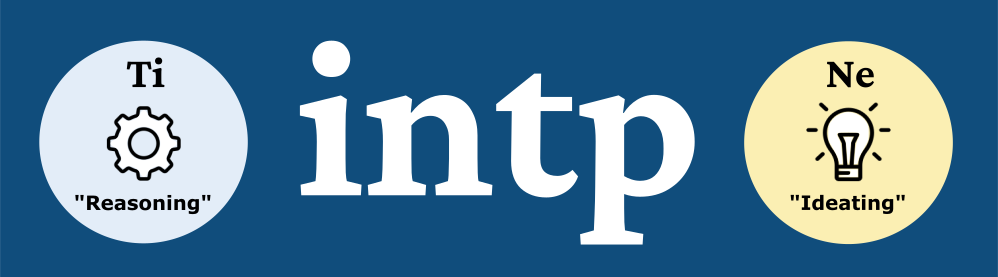
The INTP personality type is the most independent and philosophical of the 16 types. INTPs have a deep need for personal autonomy and freedom of thought.
While they may not discover their intellectual side quite as early as an INTJ might, once their auxiliary function, Extraverted Intuition (Ne), has been fully awakened, INTPs display an insatiable appetite for ideation and theorizing. Many enjoy exploring unifying theories and metaphysical truths that explain the underlying nature of things. Toward this end, they may devour stacks of books on philosophy, religion, psychology, evolutionary theory, and the like.
When vacationing from their philosophical investigations, INTPs, like their ENTP counterparts, can be quirky, witty, and engaging. Due to their extraversion of Intuition (Ne) and Feeling (Fe), INTPs can have a certain charm, approachability, and congeniality about them. When discussing a topic that interests them, they can be stimulating conversationalists, as their ever active minds can easily connect one topic to another, paving the way for a multifaceted and broad-ranging dialogue. If disinterested however, such as when forced to endure protracted small talk, they will quickly zone out or find a way of redirecting the conversation. Despite appearing outwardly genuine and personable, INTPs are more interested in discussing ideas than the mundane details of people’s lives. They enjoy discovering what makes people tick—their motivations, interests, patterns, and propensities. This allows INTPs to further hone and refine their theories (Ti-Ne) of human nature (Fe).
Like other introverts, INTPs can be anxious and self-conscious characters. It is not uncommon for them to display a handful of nervous habits, or at least some sign that they are not at ease. They generally avoid direct eye contact, as though the gaze of their interlocutor may somehow harm them or render them incapable of thinking or communicating. INTPs often have enough insecurity about the discombobulated nature of their Ne expressions in the first place. Feeling that someone else is watching or critiquing them only makes it worse. Like the INFP, INTPs can be slow to disclose the contents of their inner world. As strange as it may seem to other types, INTPs often conceal some of their most dominant personality features, namely, their highly cerebral and rational side. It may only be a select few who are granted full access to this side of the INTP. Others may only encounter INTPs’ inner world through encounters with their work, such as by reading something they have written. This may explain why many INTPs often take interest in writing, which provides an excellent forum for expressing themselves more fully and precisely.
Because of their reluctance to freely display the rational dimension of their personality, as well as the scattered nature of their Ne expressions, INTPs often feel their true level of knowledge and competence goes unnoticed by others. This is especially common in the workplace, where their lack of enthusiasm for organizational life, combined with their quirky outward demeanor, may be mistaken for incompetence. As discussed in our post on INTP careers, they can struggle to find satisfying jobs within the system and are often happier functioning as freelancers or entrepreneurs.
When it comes to relationships, INTPs can also have a rough go of things (see our INTP relationships page for more on this). While they can use their Ne and Fe to attract potential mates, their tug-of-war between Ti and Fe, between their independence (Ti) and relationships (Fe), can inspire myriad problems. This will be elaborated later in this profile in our section on Fe.
INTP Personality Type Development & “Function Stack”
Each personality type prefers four of the eight functions first described by Jung. These four functions make up the “function stack.” The relative strength of preference for these four functions is expressed in the following manner: dominant, auxiliary, tertiary, inferior. INTPs’ first preference is Ti, followed by Ne, Si and Fe respectively. This is depicted in the arrangement of INTPs’ function stack:
INTP Function Stack
Dominant: Introverted Thinking (Ti)
Auxiliary: Extraverted Intuition (Ne)
Tertiary: Introverted Sensing (Si)
Inferior: Extraverted Feeling (Fe)
While we will soon discuss each of the above functions in greater depth, for now, we will turn our attention to another feature of INTPs’ personality, their type development. As is true for other types, their type development consists of three primary phases.
Phase I (Childhood)
This phase is characterized by the emergence and differentiation of INTPs’ dominant function, Introverted Thinking (Ti). Early in life, INTPs often employ their Ti to focus on one or two pursuits. They may, for instance, use it to master video games, program computers, get good grades, or perfect their 5 K time. Since Ti is a Judging function, INTPs often take themselves and their lives rather seriously. Even from a young age, they can be self-starters, striving for excellence in whatever captures their interests.
Phase II (Adolescence-30s)
Once their dominant Ti reaches a certain level of consciousness and differentiation, INTPs’ inferior function, Extraverted Feeling (Fe), enters the picture and begins to play a more influential role. Phase II INTPs also show increasing use and development of their auxiliary function, Extraverted Intuition (Ne). During this phase, INTPs often develop a stronger interest in intellectual and philosophical endeavors, poised to see and understand “the big picture.” Developing their Ne involves an opening of prior judgments to allow an influx of new information. But since Ne is extraverted and expansive, INTPs must explore a breadth of ideas before they feel confident about who they are and what they believe. Thus, Phase II INTPs may find it easier to identify what they don’t believe than what they do believe. Some may struggle with nihilism or cynicism, worried that they may never find absolute truth. It can therefore take INTPs a great deal of time, even decades, to discern what they believe about the world, themselves, and their place in the world.
Phase III (30s, 40s, & Beyond)
If all goes well and they are fortunate enough to enter Phase III, INTPs experience greater balance between their dominant Ti and inferior Fe functions. They discover that growth and integration takes place rather naturally as they learn to effectively and consistently employ their type’s strengths (i.e., their Ti and Ne).
INTPs’ Dominant Function: Introverted Thinking
As enumerated in my INTP book, Ti involves the application of logic and reason for the sake of understanding a given situation, system, or problem. INTPs use Ti to bring structure and order to their inner world, granting them a strong sense of inner control. Inwardly, INTPs are highly self-disciplined, working to effectively manage their thoughts and their lives. The disciplined nature of their Ti compels INTPs to frame many things as a goal or challenge. These challenges may be physical (e.g., trying to achieve an ideal state of health or fitness), intellectual, practical, psychoemotional (e.g., becoming self-actualized), or later in their development, interpersonal (e.g., “perfecting” a relationship or becoming a skilled lover). In order to succeed in these personal challenges, INTPs are apt to impose rules on themselves. However, because of the wayward influence of their auxiliary Ne, they commonly end up breaking or sabotaging them.
INTPs are also less interested in working with facts than with ideas. Jung writes: “His ideas have their origin not in objective data, but in his subjective foundation.” INTPs are constantly digging into the background of their own thoughts in order to better understand their origins and to ensure their thinking is founded on solid reasoning. They see it pointless to try to build theories on a dubious conceptual platform, making them slower than Te types to rush into experiments to discover more “facts.”
INTPs often find it easier to identify inconsistencies or logical shortcomings—to assert what is not true—than to identify and confidently assert what is true. They can quickly locate inconsistencies or logical shortcomings in a given theory or argument. They excel when it comes to identifying exceptions or imagining scenarios in which the proposed explanation could breakdown. Due to their sensitivity to theoretical exceptions, they can be quick to throw theories and start from scratch. INTJs, by contrast, seem less deterred by ostensible exceptions, perhaps feeling that they will eventually be explained or otherwise rectified.
When functioning constructively, INTPs, like INFPs, often employ a trial-and-error sort of approach to building their theories and ideas. INTPs start with a given (Ti) and then use their auxiliary Ne to explore various connections and possibilities. They also integrate past experiences and acquired knowledge through their tertiary Si. It is usually only after years of toying with ideas that something resembling a systematic and coherent theory may start to emerge.
INTPs’ Auxiliary Function: Extraverted Intuition
INTPs use Extraverted Intuition (Ne) as their auxiliary function. Ne can function either perceptively or expressively. The verbal expression of Ne amounts to something like “brainstorming aloud.” When orating, INTPs may not always seem to “have a point” as they haphazardly drift from one idea to the next. Even ideas that seem inwardly logical and sensible INTPs may suddenly sound incoherent when they attempt to convey them through their Ne.
In its receptive role, Ne prompts INTPs to gather information. Ne does not merely gather sensory information as Se does. Rather, it goes beyond or looks behind sense data, allowing INTPs to discern otherwise hidden patterns, possibilities, and potentials. Their Ne is constantly scanning for relationships or patterns within a pool of facts, ideas or experiences. INTPs commonly use this receptive side of their Ne in activities such as reading, researching, and conversation. They enjoy asking questions that allow them to gain insight or knowledge from others, making INTPs good facilitators of conversation.
INTPs may also use their Ne to sniff out intriguing possibilities. They commonly enjoy and assume the role of wanderer or seeker, rarely knowing in advance exactly what they are seeking.
Ne also confers an open-mindedness, helping INTPs see truth on both sides of an issue without forming unwarranted judgments or premature conclusions. More specifically, their Ne can be seen as contributing to their openness to alternative or Bohemian lifestyles. INTPs are those most likely to suddenly become vegetarians, join a commune, or decide to live out of the back of a van. They are drawn to the idea and challenges of an unconventional lifestyle.
Like other NPs, INTPs often have a love-hate relationship with their Ne. They love the fact that it helps them remain open-minded and grasp the bigger picture. But living with Ne also has its challenges. For one, it can make it difficult for INTPs to arrive at firm conclusions or make important decisions. It often seems that at the very moment they are feeling good about a given conclusion or decision, their Ne steps in and causes them to start doubting it again. This has obvious implications for INTPs who are trying to find their niche in the world. This can leave them feeling discouraged and restless, worried that they may never find what they are looking for. They may feel frustrated by their seeming lack of progress toward anything substantial. The fact is that INTPs desperately want to produce something of lasting worth or value, but they also want to ensure they get it right. They don’t want to leave any stone unturned before arriving at a conclusion. While INTPs typically enjoy this quest for truth, there comes a point when they begin to feel the pressures of life impinging on them. Questions about careers and relationships loom large as they enter their late twenties and thirties. This can be frustrating to INTPs as they feel like life is requiring them to make decisions long before they are ready. As is true of all IN types, they feel that life would be far better if they weren’t forced to consider practical concerns.
INTPs’ Tertiary Function: Introverted Sensing
Unlike Ne (or Se), INTPs’ tertiary function, Introverted Sensing (Si), is a conservative function. It involves an attachment to past experiences and past precedent—to the routine, familiar, and predictable. Types with Si in their function stack, including INTPs, tend to eat a fairly routine or consistent diet, “eating to live” rather than “living to eat.” Si types are not only conservative with regard to their diet, but with respect to the material world in general. They tend to be savers rather than spenders, seeing excessive material consumption as unnecessary, or perhaps even immoral.
Like other Si types, INTPs also have a diminished need for novel physical pleasures, lavish surroundings, or material comforts. They are minimalists to the core, relatively unconcerned with their physical surroundings.
An often overlooked role of Si is its perception of internal bodily sensations—the body as felt and experienced from within. Perhaps more than any other function, it provides access to the raw and basic sense of “being” that exists apart from thought or outward stimuli. Historically, Eastern philosophical and religious traditions have done a much better job exploring this dimension than those of the West. This feature of Si is brought to the fore during activities requiring close attention to one’s internal bodily state, such as yoga, Tai-Chi, meditation, or various relaxation techniques. INTPs interested in exploring this element of Si may find great delight and benefit from these sorts of practices. They are especially useful in developing the body awareness necessary to relax and control anxiety.
INTPs’ Inferior Function: Extraverted Feeling
Last but not least, Extraverted Feeling (Fe) serves as INTPs’ inferior function. While having inferior feeling doesn’t make INTPs emotionless robots, their feelings do seem to have a mind of their own, often coming and going as they please. Realizing how hard it can be to voluntarily contact or summon their emotions, INTPs tend to feel awkward and uneasy in emotional situations. Although they may be cognitively aware of the appropriate emotional response, if they’re unable to directly tap into their feelings, INTPs can appear clumsy, mechanical, or disingenuous. This can be unsettling to others who are looking for outward signs of authentic emotion from the INTP.
Fe is also concerned with maintaining social harmony. While Ti and Ne may inspire INTPs to function as provocateurs, their Fe encourages them to operate as peacemakers. Far more often than INTJs, INTPs will “bite their tongue” in order to avoid hurting or offending others. Doing so also minimizes the likelihood of emotionally-volatile situations which can engender anxiety and disquiet in this type.
Another aim of Fe involves establishing emotional rapport and connection with others. But again, while INTPs may do at fair job at reading others’ emotions, they may fail to actually “feel” what the other person is feeling. This is why INTPs are sometimes described as “outwardly warm, but inwardly cold or calculating.” Fe can be a bit of an act in the first place (e.g., political glad-handing), but this seems particularly commonplace among INTPs and ISTPs. Although casual social engagement may help them feel good for a while, perhaps even give them an ego boost, without sufficient Ti stimulation, it won’t be long before they’re scoping out the nearest exit.
Finally, it’s not unusual for INTPs to oscillate through phases in which they feel they don’t need other people at all. Especially when their work life is running on all cylinders, they can feel invigorated and invincible. But the psyche will only permit this sort of Ti lopsidedness for so long. Eventually, INTPs start feeling a bit lonely or empty, sensing that something important is missing from their lives. This prompts them to reinitiate contact with others, at least until they feel compelled to reassert their independence. Striking a balance between their independence (Ti) and relationships (Fe) can thus constitute a lifelong challenge for this personality type.
Learn More in Our INTP Book:
Learn more about INTPs—their personality, careers, relationships, cognition, life struggles, and more—in our INTP book (the #1 INTP book on Amazon with over 300 reviews):
The INTP: Personality, Careers, Relationships and the Quest for Truth & Meaning
#1 INTP Book
on Amazon
#1 INTP Book
on Amazon!
Unsure if You’re an INTP or INTJ?
Take Our INTJ-INTP Type Clarifier Test
Related Posts:
INTP Famous People / Celebrities:
Spinoza, Kant, Schiller, Chomsky, Bill Gates, Herbert Spencer, Einstein, Fichte, Bergson, Robert Pirsig, Christian Wolff, Paul Tillich, Viktor Frankl, Edward Snowden, Paul Ricoeur, Karl Jaspers, Madame Curie, Hannah Arendt, Woody Allen
*Portions of this INTP profile are also likely to resonate with Enneagram Fives (5w4, 5w6).


Greg says
It’s astonishing how accurate this is (for me at least). I don’t quite understand why, as it’s not a true science, but I expect it is supported by a great deal of circumstantial evidence via case studies. Self knowledge can be a wonderful thing…
Thanks
Rob says
I feel the exact same way. It’s uncanny how much this profile seems to fit me.
Brittney says
This article has been very insightful, Thank You.
Before finding out about personality types and as a female INTP in her early 20s, I’ve often felt like there was something wrong with me. I can spend a lot of time internalizing various situations and ideas. However the biggest challenge for me since childhood has been with friends and family members, as they’ve struggled to understand my lack of emotional connection and reactions to them. When it comes to creating lasting relationships, I value honestly and transparency. If I can’t read a persons intentions, it can be very hard for me to want to get to know them and I can easily disconnect. Independence is something I value highly and having it compromised in any way can make me feel like I’ve lost a significant part of my identity. After reading this, it all makes sense. Having these insights will help me grow as a person, safe in the knowledge that my strengths and weaknesses are perfectly normal and expected as an INTP. I’m sure that many of you can relate.
Shikha says
I can relate. I too am an INTP female and it’s not easy. Like Newton, I wonder and wish I could simply enjoy life. But rather, I like my pursuits to be great and living with the societal structure is difficult. As I read through the phases of development, I just wish I get out of Phase II.
Sussex says
yup, I hear you. I feel the same way and about this article too. INTP is so me!!
Confetti says
Same. INTP female in her middish 20’s here and I couldn’t agree more. I very rarely even leave comments on things, but I felt like you should know you aren’t as alien as you feel. I’ve been aware of that feeling my entire life, and MBTI has really helped understand so much.
I also don’t know if this is a thing with other INTP females, but when it comes to a partner they must be completely transparent and authentic. I cannot date fake people or even sleep with the majority of typical males, complete turn off for me what most generally consider attractive. I’ve tried to explain this people and most women just do not get it…
Julian says
This is so funny. I can relate to nearly all of this. What I find most shockingly accurate are these:
The part about not being skeptical as a child due to lack of Ne. And my love and obsession with getting good at maths, complicated puzzles and video games. Then the overbearing consequences of developing Ne (around age 11) and suddenly questioning everything I was so sure of.
The part about being a minimalist and being consistent with my diet. And my curiosity for exploring my bodily sensations through meditation to control my anxiety, all of this due to my new Si.
Being compelled to frame everything as an internal goal towards which I can take action (particularly social skills).
And most hilarious of all: the fact that I get so much happiness from romantic comedies and sappy love songs because of my longing for affection, yet my inability to actually generate any sort of emotional connection with people when I’m around them. Also the part about longing for FJs’ Fe explains the uncontrollable attraction I feel towards those types.
Justin says
As you are all pretty much saying, it’s extraordinary how relatable this is. Every single thing I read in this article was spot on, and the things I have yet to experience that INTP’s usually come across, if getting through the second stage mentioned. I’m 16 and I have isolated myself from everyone in my life and I have become quite pessimistic, I feel more mature and aware than my peers and having dealt more hardships than most people do in their childhood I feel like it has made me like an adult in a child’s body that still lacks experience . After reading this I can imagine I’m not the first to feel this way.
Rachel says
I’m 17 and feel the exact same way you do in terms of feeling more mature than peers and feeling like an adult trapped in a kid’s body. Ever since I hit junior high school I’ve found it hard to make connections with my peers because of this. I do believe it will get better, though. At least there are others who have had/are having the same experience we’re going through.
David says
I consistently type as INTP and this profile is pretty much spot-on for me. The BIG question I have (and makes me wonder about the accuracy of typing as INTP) is that most OTHER profiles of this type paint a picture of someone whose Ti function drives them to be “brutally honest” with others in defense of logic and what they perceive to be truth — even at the cost of social/interpersonal harmony and relational integrity.
However, this has NEVER been the case for me — in fact, I may be EXCESSIVELY concerned with avoiding conflict and/or stating my beliefs (if contrary to others), and come across as very friendly with family and co-workers.
AJ’s description of how the (inferior) Fe function — how it seeks to maintain harmony and avoids expressive judgement — would coincide with my experience. But he also states that being the inferior function, it is less conscious and has a life of it’s own (showing up as all or nothing). In my experience, Fe is ALWAYS on, keeping me in check (socially) and seeking harmonious relationships.
João says
Hi David
Just like you, I tested consistently as an INTP (from several tests). In the majority of the INTP traits descriptions I always found that my personal experience contradicted the ‘Brutally honest’ trait you mention. AJ’s description of Fe role is much more in agreement with my life experiences.
Renier John says
this is Great.
daniel says
Beautiful. Thank you everybody. So very insightful.
Georgia says
this is amazing
does anybody else feel like they have to dumb themselves down to get along with people? I hate even saying that because it sounds so pretentious but its true!! I feel like this is a safe place to say this haha. I feel like I’ve only had a real connection and friendship with maybe 2 or 3 people in my 19 years of life, if that. And I even dumbed myself down for those people. Most people dismiss me as stupid and empty headed, maybe that has a lot to do with the fact I’m female and introverted. I get so frustrated
Maria says
Exactly me. To the T!!
Pooja Garg says
It freakishly explained almost everything I have felt and experienced over the last few years which I have just been trying to make sense of by going to various levels of philosophy and theories. Wow! I think somewhere now, I don’t feel that the way I was acting is totally mad. I must say, my five years younger self was NOT prepared for these kind of changes and growth!!
Barbara says
It’s very interesting the way this can peg me down, it’s a personality type but it seems all of my outer structure is here. I think it helps immensely that the guy who wrote this is an INTP. Anytime I would think, wait, that seems little off, he adds something in the end that’s like damn, there I am. For example. putting rules on myself, I do this all the time but I also end up breaking them, which he mentions. It’s just craziness…
Thanks for making this, it cleared up a lot of things for me :)